The United States Supreme Court Hears All Cases Sent to It for Review
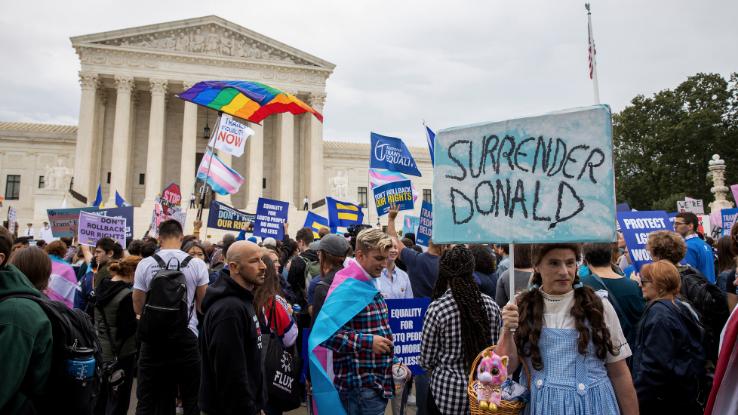
When Justice Ruth Bader Ginsburg passed abroad on September 18, 2020, many Americans didn't take the proper time to grieve — instead, they panicked about what her passing meant for the time to come of the country. Belongings the balance of an entire democracy is likewise great a burden for anyone'southward shoulders, and Justice Ginsburg had been carrying that weight for a long, long time. Instead of property infinite for her passing, Republican politicians wasted no time in queuing upward a nominee for the empty Supreme Court seat, somewhen landing on Amy Coney Barrett — a longtime Notre Dame Constabulary School professor who served fewer than iii years on the 7th Circuit earlier her nomination to the highest court in the American judicial organisation.
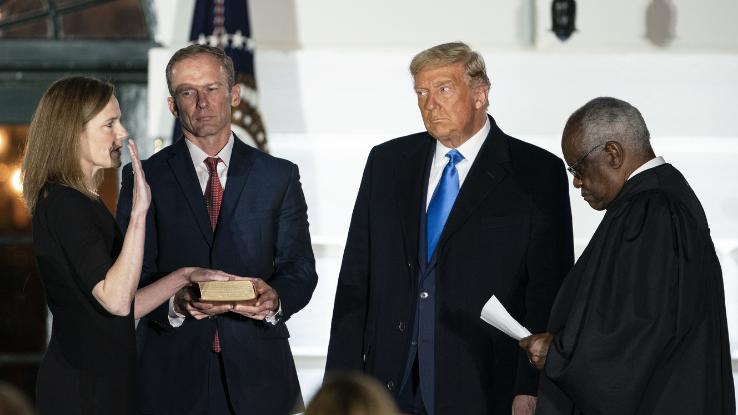
In 2016, then-Senate Majority Leader Mitch McConnell infamously vowed to block President Obama's outgoing Supreme Courtroom nomination of Merrick Garland on the grounds that the American people should have a "voice" and that to rush a nomination (and confirmation) would be to overly politicize the upshot. In 2020, nevertheless, McConnell didn't hold to those principles he outlined 4 years earlier, leading to Barrett'southward confirmation hearings and equally rushed swearing in anniversary, which took place nearly a week before Election Twenty-four hours on October 26, 2020.
This move led many to criticize McConnell, including New York Representative Alexandria Ocasio-Cortez (@AOC), who simply tweeted, "Aggrandize the court." Additionally, Massachusetts Senator Ed Markey (@EdMarkey), who is Ocasio-Cortez's Green New Deal co-author, tweeted, "Mitch McConnell set the precedent. No Supreme Court vacancies filled in an election year. If he violates it, when Democrats control the Senate in the next Congress, we must cancel the filibuster and expand the Supreme Court."
The Number of Supreme Court Seats Has Been Adjusted Before — Here's How It's Done
This telephone call for a SCOTUS expansion has led many to wonder: Is such a move even possible? The short answer: yes. Congress could easily modify the number of seats on the Supreme Court bench. According to the Supreme Courtroom's website, "The Constitution places the power to determine the number of Justices in the hands of Congress" — simply some other example of those supposed checks and balances that guide a constitutional authorities. In fact, the number of Justices has shifted several times throughout the Court'south history. In 1789, the first Judiciary Act set the number of Justices at half dozen; during the Civil War, the number of seats went up to nine so briefly 10; and, in one case President Andrew Johnson took office, Congress passed the Judicial Circuits Act in 1866, cutting the number of Justices to seven then that Johnson couldn't stack the court in favor of Southern states.
Since 1869, nonetheless, the Supreme Court has been composed of nine Justices. In semi-recent history, there's been ane notable attempt to aggrandize the Court — one that volition live in infamy, and so to speak. Back in 1937, President Franklin Delano Roosevelt aimed to aggrandize the Courtroom, which kept shooting down some of his New Bargain legislation. More specifically, FDR felt that many of the older Justices were out of touch with the times, so much so that they were colloquially dubbed the "9 one-time men."
FDR's proposal? Add one Justice to the Supreme Courtroom for every seventy-year-one-time Justice residing on the bench. That would've resulted in 15 Supreme Court Justices, but even the Democrat-controlled Congress — and FDR's own Vice President — were against the idea. Since FDR's infamous defeat, no attempt to expand or reduce the Supreme Court has gathered much steam — until now.
How Likely Is It That Democrats Will Expand the Supreme Court in 2021?
Interestingly enough, Politico points out that President Biden has been outspoken about not expanding the court. In 2019, President Biden even went as far as maxim "we'll live to rue that day [we expand the Court]," arguing that an expansion would lead to constant changes — more expansions, more reductions. In short, it would shake the American people'south organized religion in the legitimacy of the Supreme Court (and potentially the Autonomous political party). Of grade, that'south but i scenario — and ane that hasn't happened in the past. Just, in the past, Vice President Kamala Harris has shown some support for the idea, saying she'd exist "open" to it. All the same, both Vice President Harris and President Biden have also dodged questions surrounding court-packing and Supreme Courtroom expansion.
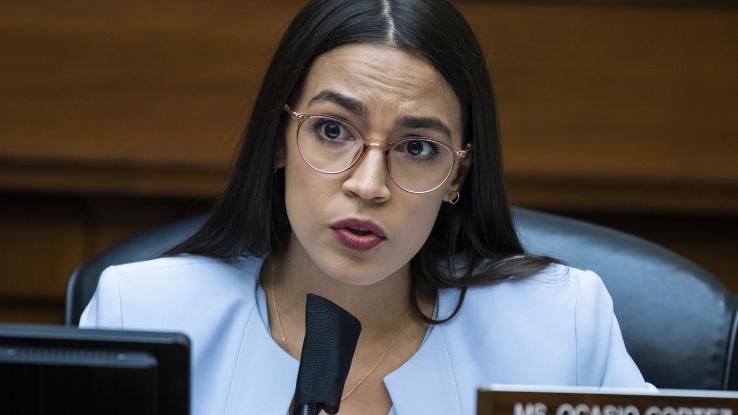
On the other paw, more outspoken proponents have tried to assemble momentum for the thought. Representative Ocasio-Cortez expanded upon her initial "Expand the Court" tweet, calling out Republicans' hypocrisy toward appointing new Justices during presidential election years. "Republicans do this because they don't believe Dems take the stones to play hardball like they practise. And for a long time they've been correct," Ocasio-Cortez tweeted. "Just do not let them bully the public into thinking their bulldozing is normal but a response isn't. At that place is a legal procedure for expansion."
In the face of a half dozen–3 Bourgeois majority, folks like Representative Ocasio-Cortez argue that the Supreme Court is out of balance — and, more that, information technology isn't quite reflective of the American people's concerns and values. So much lies in the hands of the court: the fate of the Affordable Care Act, Roe v. Wade and wedlock equality, merely to name a few. Now, we'll just have to see if this imbalance — and Barrett's speedy date — are enough to convince President Biden and members of Congress to seriously consider a Supreme Court expansion.
Source: https://www.ask.com/culture/ask-answers-expand-supreme-court?utm_content=params%3Ao%3D740004%26ad%3DdirN%26qo%3DserpIndex
0 Response to "The United States Supreme Court Hears All Cases Sent to It for Review"
Post a Comment